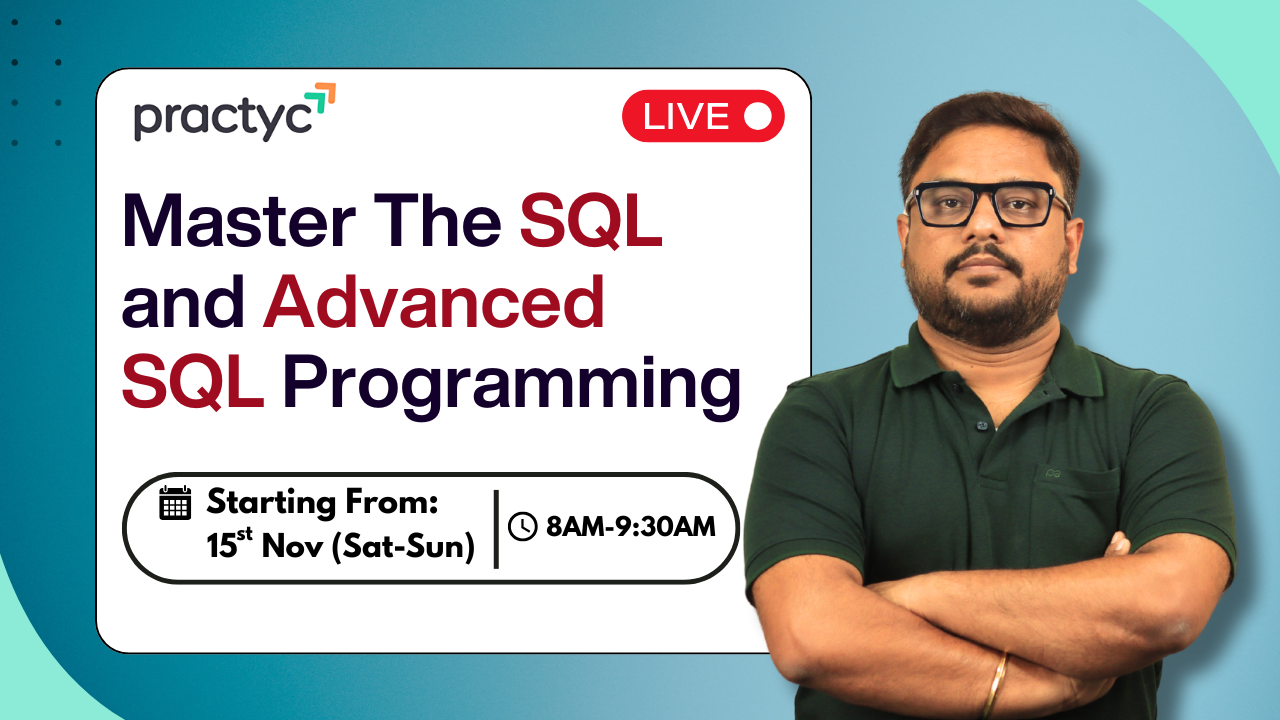
Live Cohort : Master The SQL & Advanced SQL Programming
 Database Design & Development
 SQL Server
Modules
12
Classes
LIVE12
Labs
7
Duration
11 hr 56 min
Start Date
Nov 15, 2025
End Date
Dec 14, 2025
This Cohort Includes

Live Lectures
Interactive live sessions with real-time doubt resolution.

Expert Support
Direct access to industry mentors for personalized guidance.

Hands-on Labs
Practical training sessions with real-world applications.

Recognition
Official certification recognized by top-tier organizations.
Cohort Curriculum
12 modules


About This Cohort
Unlock the true power of data with this hands-on, live cohort designed to take you from SQL fundamentals to advanced programming mastery. Whether you're an aspiring data analyst, business intelligence professional, or developer, this program helps you think in SQL—not just write queries.
Through live interactive sessions, real-world case studies, and guided projects, you’ll learn how to extract, transform, and analyze data efficiently across different databases like SQL Server.
Learning Outcome
What You’ll Learn
- SQL Foundations: Joins, subqueries, aggregations, and filtering for real business use cases.
- Advanced SQL Programming: Window functions, CTEs, stored procedures, triggers, and performance optimization.
- Data Analytics with SQL: Turning queries into insights using real datasets.
- Query Optimization: Write efficient and scalable queries used in enterprise systems.
- Interview & Project Readiness: Solve analytics challenges and SQL interview questions confidently.
Why Join This Live Cohort
- Learn live with an instructor, not from pre-recorded videos.
- Get hands-on practice with assignments and mini-projects.
- Access personal mentorship and query reviews.
- Become industry-ready for data roles (Analyst, Engineer, Scientist).
Ratings & Reviews
Student Feedback
Overall Rating
"Really insightful and well-structured masterclass by Rahul Neekhra on the Data Engineers & Data Architects Interview Playbook. Rahul explained the interview process and expectations in a very practical and easy-to-understand way. I especially liked the focus on how to approach real-world scenarios and present our experience effectively rather than simply memorizing answers. The session provided a clear perspective on what interviewers look for and how to prepare with the right mindset. Overall, a very valuable session for anyone preparing for Data Engineering or Data Architecture interviews. Highly recommend Rahul as an instructor!"
Pragya Neekhra
Aug 28, 2026
"This master class exceeded my expectations. I learned about the latest Data Engineering technologies, project architecture, and interview preparation strategies. The session was highly valuable for both beginners and experienced professionals."
Santosh Kumar
Aug 17, 2026
"The masterclass was very well organised. Satisfied with the contents on offer in the 3 hours."
Narse Nishad
Aug 9, 2026
"I booked a free career guidance session with Rahul Sir through Practyc. Before the session, I was a bit skeptical and wondered if it would mainly be about selling his cohort. However, my experience was completely different. Rahul sir is genuinely experienced and took the time to understand my background, goals, and current situation. Instead of giving generic advice or pushing any course, he provided a clear and practical roadmap tailored to my career aspirations. The session helped me solidify my understanding of the field and gave me much more clarity about the next steps I should take. I really appreciate his honest guidance and the value he provided during the session. If you're looking for genuine career advice from someone who truly understands the industry, I would definitely recommend booking a session with him."
Debasish Mishra
Aug 3, 2026
"I attended the ETL Cohort demo session and later booked a 1:1 call with Rahul to clarify a few doubts before enrolling. As someone with 8 years of experience working as a Senior Data Engineer, primarily on Azure and Databricks, I was initially a bit skeptical because Databricks wasn't a major part of the syllabus. However, the conversation completely changed my perspective. Rahul explained how technologies like Databricks and Snowflake are essentially platforms built on strong data engineering fundamentals, and why mastering the core concepts is far more important in the long run. We discussed topics like Data Modeling, Data Warehousing, SCDs, Lakehouse architecture, Governance (PII, masking, compliance), and Streaming—not just what they are, but why they exist, when to use them, and the intuition behind them. That practical way of explaining concepts really stood out. What impressed me the most was his patience. Although the session was scheduled for 15 minutes, he spent over 30 minutes answering every question without rushing. At no point did it feel like a sales call—it was an honest technical discussion focused on clearing my doubts. Based on this interaction, I've decided to enroll in the cohort. While the real experience will ultimately depend on how the batch is delivered, my first impression has been very positive, and I'm genuinely looking forward to the learning journey. If you're someone who has doubts or is unsure whether to join, I'd definitely recommend booking a 1:1 session first. It helped me make an informed decision. Thanks, Rahul, for taking the time and patiently addressing all my questions."
Chandrakanth Chandru
Aug 1, 2026
"Thank you Rahul for clear guidance and instructions on how to goahead. As I was from different background this will help me to explore more into Data engineering role."
Upendra Naik
Aug 1, 2026
"The best part of this question bank that it explains the right and wrong answers in detail. This helps to validate the answers both right and wrong. It helps alot!"
Rahul Neekhra
Jul 25, 2026
"Cleared all my doubts and suggested right path to be more relevant in IT industry Thank you for your guidance"
Arnab Majumder
Jul 25, 2026
"I was confused where to start, Rahul give me a perfect and practically implementable roadmap to start with less time. Thanks Rahul for your guidance and time."
Azeem Aftab
Jul 24, 2026
"Such an amazing experience with Rahul sir, cleared all the doubts regarding the program along with the guidance that is provided in such a short call"
Ayush Choubey
Jul 20, 2026
"It was an eye open session with Rahul neekhra as i was unable to make decision in which role and path i should go . He guided me very well to choose the career path and technology i should focus . I strongly recommend his guidance if one need any guidance about role and technology. Even his course fees are very affordable to pay ."
Anand Reddy
Jul 20, 2026
"The hands-on exercises helped reinforce key concepts such as databases, schemas, warehouses, tables, and basic SQL. A great course for beginners as well as professionals looking to strengthen their Snowflake foundation"
Sumanta Kar
Jul 14, 2026
"I had a great discussion with you about my skills and my transition into Data Engineering. He patiently reviewed my background, understood my goals, and provided clear, practical guidance on how to make the switch successfully. His advice was honest, insightful, and gave me a clear roadmap to start my Data Engineering journey with confidence. What impressed me the most was that he offered all this guidance completely free of cost, genuinely wanting to help. I truly appreciate his time, knowledge, and willingness to mentor others. I highly recommend connecting with him if you're looking for career guidance or planning a transition into Data Engineering."
Sumanta Kar
Jul 13, 2026
"I had an amazing one to one call with Rahul. He provided me with all the points necessary before a major interview. His way of explaining the concepts is accurate and to the point. He listens to all the queries and promptly provides the solution for them."
Shashi Choudhary
Jul 10, 2026
No written review.
Abhishek Nagane
Jul 10, 2026
"Informative session."
Sudhanshu Kumar
Jul 9, 2026
"The Apache Spark Architecture session was extremely valuable and insightful. The concepts were explained clearly with practical examples, making it easy to understand the architecture and real-world implementation. The trainer was knowledgeable, engaging, and addressed all questions effectively. Overall, it was an excellent learning experience, and I look forward to attending more such sessions in the future."
Sudharshanreddy A5
Jul 7, 2026
"The session was good."
Vinod Biradar
Jul 7, 2026
"⭐⭐⭐⭐⭐ I had a great experience connecting with Rahul Sir for guidance on the Data Engineering roadmap. He provided a clear, structured, and practical learning path, making it easy to understand what to focus on at each stage. He patiently answered all my questions and shared valuable insights based on his experience. His guidance has given me the confidence and clarity to move forward in my Data Engineering journey. I truly appreciate his time, support, and mentorship. Highly recommended to anyone looking for genuine career guidance!"
Bhakta Charan Nanda
Jul 7, 2026
"I recently attended the master class on Spark Architecture Deep Dive by Rahul Neekhra sir, and it has easily been the best session I have experienced so far. The content went far beyond a standard master class. Rahul sir explained every single concept with exceptional clarity, using highly relevant, practical examples. Additionally, he covered the most frequently asked interview questions, making the session incredibly informative and valuable for career preparation."
Pankaj Meharkule
Jul 6, 2026
"This course provides you indepth calrity with respect to spark architecture , which was always a confusing topics for me, after having this course, got a good understanding with respect to understand the cluster components and their working,aslo how to process the heavy data on distributed computing"
Siddharth Sharma
Jul 4, 2026
No written review.
Snehajit Shelke
Jul 2, 2026
"Good explanation of concepts and career oriented"
Manjunath Bg
Jul 2, 2026
"Good session. Useful"
Sreedhara Sameer Kumar Ilapavuluri
Jun 26, 2026
"Completed, Very useful to crack the interview"
S.Sriranga Prasath Prasath
Jun 12, 2026
"The way Rahul delivered the session was amazing"
Vilasagaram Saishiva
Jun 12, 2026
"Very Good experience with Rahul as mentor. He explained concepts in very well and detailed manner. Thanks Rahul for giving such an informative session."
Sachin Gorade
Jun 11, 2026
No written review.
Kundan Kumar
Jun 11, 2026
"good informative session for pyspark architecture"
Seshadri Sastry
Jun 9, 2026
"Session was good. Got to know new things"
Gaurav Patil
Jun 9, 2026
"It is completely meaningful and complete insights provided by Rahul on Apache spark."
Parag Kulkarni
Jun 8, 2026
"Had a great connect with Rahul on AI career guidance for freshers. The guidance was practical, clear, and helped understand the right direction to move forward. What stood out was the genuine discussion around real-world data engineering challenges and how one can grow into a good Data Architect. Honest guidance without any unnecessary upselling - highly recommended for anyone exploring Data Engineering."
Deo Yadav
Jun 7, 2026
No written review.
Pradeep Deshnur
Jun 7, 2026
"Its good"
Mohd Irfan Shahid
Jun 6, 2026
No written review.
Magesh S
Jun 6, 2026
No written review.
Pavan R Rao
Jun 6, 2026
"The content is good"
Pratyush Gupta
Jun 4, 2026
"Good master class, i learnt a lot. Keep it up Rahul, thak you for the wonderful session"
Dineshkumar Bm
Jun 2, 2026
"No communication regarding class timings. Emailed. No response. Got response after class. Pls accommodate in next class"
Prashant Mahapatra
Jun 1, 2026
No written review.
Venkata Amarnath
Jun 1, 2026
"It's a very good session with a lot of details on Spark and even the scenario QnA was awesome"
Maheshchandra R
May 31, 2026
"The training session was very useful and covered the topics in a practical and easy-to-understand manner. It enhanced my understanding of the concepts and provided valuable industry insights."
Manickavelayuthum Rajkumar
May 29, 2026
"Excellent session"
Pramod Pawar
May 29, 2026
"Session was highly informative. Instructor explained each and every topic very well."
Dilip Mishra
May 29, 2026
No written review.
Surya Teja
May 29, 2026
"In depth and easy explanation of complex topics"
Rajan Joshi
May 29, 2026
No written review.
Srinivas Rao
May 29, 2026
"4 hours session gives more Spark knowledge and highly recommend"
Jilan Shaik
May 28, 2026
No written review.
Pavan R Rao
May 28, 2026
"This Spark Architecture Masterclass was extremely informative and well-structured. The concepts were explained clearly with practical examples, making complex topics like DAG execution, Catalyst Optimizer, and Memory Architecture easy to understand. The real-world case study added great value and connected theory to industry use cases. Highly recommended for anyone looking to strengthen their Spark fundamentals and architecture knowledge."
Abhishek Chaukiyal Chaukiyal
May 26, 2026
"The Experience was too good. It helps to undrstand the Spark Architecture in detail deep. I am very thankful to practyc team. I learn a lot in detilas and cleared the concept like DAG architechture fault tolerance and recovery as well as spark memory architecture."
Tusharkumar Veer
May 25, 2026
"This Apache Spark Architecture Session is very useful as it contains deep detailed aspects of spark big data processing in easy manner."
Velavan P
May 25, 2026
"The spark master class was highly informative and well-structured, making complex concepts easy to understand. The instructor was engaging and practical insights provided were valuable for real world application"
Raj Me
May 25, 2026
"Got overview of the Pyspark and how it works actually Thanks"
Malik Konduri
May 24, 2026
"very informative, precise content very much helpful for understanding performance tuning, very much helpfull from interview prospect"
Anil Vainala
May 23, 2026
"good"
Kapil Dhadse
May 19, 2026
"Wonderful and engaging session"
Vinay Krishna
May 19, 2026
"Great session, it was deep dive on Spark architecture which cleared most of the doubts.Thanks"
Mithilesh Gangde
May 18, 2026
"Great sessions! very informative and interactive learned a lot."
Shailja Rai
May 16, 2026
"Wonderfull session conducted by rahul the session was very intractive"
Pranjal Gautam
May 14, 2026
"Very informative session with clear explanations and practical insights into Spark Architecture. Learned a lot about how Spark works under the hood."
Raghav Gupta
May 14, 2026
"Excellent guidance by sir"
Pranjal Gautam
Apr 26, 2026
"Great learning experience."
Rahul Neekhra
Oct 31, 2025
"Really insightful and well-structured masterclass by Rahul Neekhra on the Data Engineers & Data Architects Interview Playbook. Rahul explained the interview process and expectations in a very practical and easy-to-understand way. I especially liked the focus on how to approach real-world scenarios and present our experience effectively rather than simply memorizing answers. The session provided a clear perspective on what interviewers look for and how to prepare with the right mindset. Overall, a very valuable session for anyone preparing for Data Engineering or Data Architecture interviews. Highly recommend Rahul as an instructor!"
Pragya Neekhra
Aug 28, 2026
"This master class exceeded my expectations. I learned about the latest Data Engineering technologies, project architecture, and interview preparation strategies. The session was highly valuable for both beginners and experienced professionals."
Santosh Kumar
Aug 17, 2026
"The masterclass was very well organised. Satisfied with the contents on offer in the 3 hours."
Narse Nishad
Aug 9, 2026
"I booked a free career guidance session with Rahul Sir through Practyc. Before the session, I was a bit skeptical and wondered if it would mainly be about selling his cohort. However, my experience was completely different. Rahul sir is genuinely experienced and took the time to understand my background, goals, and current situation. Instead of giving generic advice or pushing any course, he provided a clear and practical roadmap tailored to my career aspirations. The session helped me solidify my understanding of the field and gave me much more clarity about the next steps I should take. I really appreciate his honest guidance and the value he provided during the session. If you're looking for genuine career advice from someone who truly understands the industry, I would definitely recommend booking a session with him."
Debasish Mishra
Aug 3, 2026
"I attended the ETL Cohort demo session and later booked a 1:1 call with Rahul to clarify a few doubts before enrolling. As someone with 8 years of experience working as a Senior Data Engineer, primarily on Azure and Databricks, I was initially a bit skeptical because Databricks wasn't a major part of the syllabus. However, the conversation completely changed my perspective. Rahul explained how technologies like Databricks and Snowflake are essentially platforms built on strong data engineering fundamentals, and why mastering the core concepts is far more important in the long run. We discussed topics like Data Modeling, Data Warehousing, SCDs, Lakehouse architecture, Governance (PII, masking, compliance), and Streaming—not just what they are, but why they exist, when to use them, and the intuition behind them. That practical way of explaining concepts really stood out. What impressed me the most was his patience. Although the session was scheduled for 15 minutes, he spent over 30 minutes answering every question without rushing. At no point did it feel like a sales call—it was an honest technical discussion focused on clearing my doubts. Based on this interaction, I've decided to enroll in the cohort. While the real experience will ultimately depend on how the batch is delivered, my first impression has been very positive, and I'm genuinely looking forward to the learning journey. If you're someone who has doubts or is unsure whether to join, I'd definitely recommend booking a 1:1 session first. It helped me make an informed decision. Thanks, Rahul, for taking the time and patiently addressing all my questions."
Chandrakanth Chandru
Aug 1, 2026
"Thank you Rahul for clear guidance and instructions on how to goahead. As I was from different background this will help me to explore more into Data engineering role."
Upendra Naik
Aug 1, 2026
"The best part of this question bank that it explains the right and wrong answers in detail. This helps to validate the answers both right and wrong. It helps alot!"
Rahul Neekhra
Jul 25, 2026
"Cleared all my doubts and suggested right path to be more relevant in IT industry Thank you for your guidance"
Arnab Majumder
Jul 25, 2026
"I was confused where to start, Rahul give me a perfect and practically implementable roadmap to start with less time. Thanks Rahul for your guidance and time."
Azeem Aftab
Jul 24, 2026
"Such an amazing experience with Rahul sir, cleared all the doubts regarding the program along with the guidance that is provided in such a short call"
Ayush Choubey
Jul 20, 2026
"It was an eye open session with Rahul neekhra as i was unable to make decision in which role and path i should go . He guided me very well to choose the career path and technology i should focus . I strongly recommend his guidance if one need any guidance about role and technology. Even his course fees are very affordable to pay ."
Anand Reddy
Jul 20, 2026
"The hands-on exercises helped reinforce key concepts such as databases, schemas, warehouses, tables, and basic SQL. A great course for beginners as well as professionals looking to strengthen their Snowflake foundation"
Sumanta Kar
Jul 14, 2026
"I had a great discussion with you about my skills and my transition into Data Engineering. He patiently reviewed my background, understood my goals, and provided clear, practical guidance on how to make the switch successfully. His advice was honest, insightful, and gave me a clear roadmap to start my Data Engineering journey with confidence. What impressed me the most was that he offered all this guidance completely free of cost, genuinely wanting to help. I truly appreciate his time, knowledge, and willingness to mentor others. I highly recommend connecting with him if you're looking for career guidance or planning a transition into Data Engineering."
Sumanta Kar
Jul 13, 2026
"I had an amazing one to one call with Rahul. He provided me with all the points necessary before a major interview. His way of explaining the concepts is accurate and to the point. He listens to all the queries and promptly provides the solution for them."
Shashi Choudhary
Jul 10, 2026
"Informative session."
Sudhanshu Kumar
Jul 9, 2026
"The Apache Spark Architecture session was extremely valuable and insightful. The concepts were explained clearly with practical examples, making it easy to understand the architecture and real-world implementation. The trainer was knowledgeable, engaging, and addressed all questions effectively. Overall, it was an excellent learning experience, and I look forward to attending more such sessions in the future."
Sudharshanreddy A5
Jul 7, 2026
"The session was good."
Vinod Biradar
Jul 7, 2026
"⭐⭐⭐⭐⭐ I had a great experience connecting with Rahul Sir for guidance on the Data Engineering roadmap. He provided a clear, structured, and practical learning path, making it easy to understand what to focus on at each stage. He patiently answered all my questions and shared valuable insights based on his experience. His guidance has given me the confidence and clarity to move forward in my Data Engineering journey. I truly appreciate his time, support, and mentorship. Highly recommended to anyone looking for genuine career guidance!"
Bhakta Charan Nanda
Jul 7, 2026
"I recently attended the master class on Spark Architecture Deep Dive by Rahul Neekhra sir, and it has easily been the best session I have experienced so far. The content went far beyond a standard master class. Rahul sir explained every single concept with exceptional clarity, using highly relevant, practical examples. Additionally, he covered the most frequently asked interview questions, making the session incredibly informative and valuable for career preparation."
Pankaj Meharkule
Jul 6, 2026
"This course provides you indepth calrity with respect to spark architecture , which was always a confusing topics for me, after having this course, got a good understanding with respect to understand the cluster components and their working,aslo how to process the heavy data on distributed computing"
Siddharth Sharma
Jul 4, 2026
"Good explanation of concepts and career oriented"
Manjunath Bg
Jul 2, 2026
"Good session. Useful"
Sreedhara Sameer Kumar Ilapavuluri
Jun 26, 2026
"Completed, Very useful to crack the interview"
S.Sriranga Prasath Prasath
Jun 12, 2026
"The way Rahul delivered the session was amazing"
Vilasagaram Saishiva
Jun 12, 2026
"Very Good experience with Rahul as mentor. He explained concepts in very well and detailed manner. Thanks Rahul for giving such an informative session."
Sachin Gorade
Jun 11, 2026
"good informative session for pyspark architecture"
Seshadri Sastry
Jun 9, 2026
"Session was good. Got to know new things"
Gaurav Patil
Jun 9, 2026
"It is completely meaningful and complete insights provided by Rahul on Apache spark."
Parag Kulkarni
Jun 8, 2026
"Had a great connect with Rahul on AI career guidance for freshers. The guidance was practical, clear, and helped understand the right direction to move forward. What stood out was the genuine discussion around real-world data engineering challenges and how one can grow into a good Data Architect. Honest guidance without any unnecessary upselling - highly recommended for anyone exploring Data Engineering."
Deo Yadav
Jun 7, 2026
"Its good"
Mohd Irfan Shahid
Jun 6, 2026
"The content is good"
Pratyush Gupta
Jun 4, 2026
"Good master class, i learnt a lot. Keep it up Rahul, thak you for the wonderful session"
Dineshkumar Bm
Jun 2, 2026
"No communication regarding class timings. Emailed. No response. Got response after class. Pls accommodate in next class"
Prashant Mahapatra
Jun 1, 2026
"It's a very good session with a lot of details on Spark and even the scenario QnA was awesome"
Maheshchandra R
May 31, 2026
"The training session was very useful and covered the topics in a practical and easy-to-understand manner. It enhanced my understanding of the concepts and provided valuable industry insights."
Manickavelayuthum Rajkumar
May 29, 2026
"Excellent session"
Pramod Pawar
May 29, 2026
"Session was highly informative. Instructor explained each and every topic very well."
Dilip Mishra
May 29, 2026
"In depth and easy explanation of complex topics"
Rajan Joshi
May 29, 2026
"4 hours session gives more Spark knowledge and highly recommend"
Jilan Shaik
May 28, 2026
"This Spark Architecture Masterclass was extremely informative and well-structured. The concepts were explained clearly with practical examples, making complex topics like DAG execution, Catalyst Optimizer, and Memory Architecture easy to understand. The real-world case study added great value and connected theory to industry use cases. Highly recommended for anyone looking to strengthen their Spark fundamentals and architecture knowledge."
Abhishek Chaukiyal Chaukiyal
May 26, 2026
"The Experience was too good. It helps to undrstand the Spark Architecture in detail deep. I am very thankful to practyc team. I learn a lot in detilas and cleared the concept like DAG architechture fault tolerance and recovery as well as spark memory architecture."
Tusharkumar Veer
May 25, 2026
"This Apache Spark Architecture Session is very useful as it contains deep detailed aspects of spark big data processing in easy manner."
Velavan P
May 25, 2026
"The spark master class was highly informative and well-structured, making complex concepts easy to understand. The instructor was engaging and practical insights provided were valuable for real world application"
Raj Me
May 25, 2026
"Got overview of the Pyspark and how it works actually Thanks"
Malik Konduri
May 24, 2026
"very informative, precise content very much helpful for understanding performance tuning, very much helpfull from interview prospect"
Anil Vainala
May 23, 2026
"good"
Kapil Dhadse
May 19, 2026
"Wonderful and engaging session"
Vinay Krishna
May 19, 2026
"Great session, it was deep dive on Spark architecture which cleared most of the doubts.Thanks"
Mithilesh Gangde
May 18, 2026
"Great sessions! very informative and interactive learned a lot."
Shailja Rai
May 16, 2026
"Wonderfull session conducted by rahul the session was very intractive"
Pranjal Gautam
May 14, 2026
"Very informative session with clear explanations and practical insights into Spark Architecture. Learned a lot about how Spark works under the hood."
Raghav Gupta
May 14, 2026
"Excellent guidance by sir"
Pranjal Gautam
Apr 26, 2026
"Great learning experience."
Rahul Neekhra
Oct 31, 2025
Pricing
$29.00 $199.00 85% OFF
$40.27 $15.74 60% OFF
Instructor Details

Rahul Neekhra
Country: India
Industry: Data Science & Analytics
Experience: 18 years
About: I’m a Data & AI Solutions Architect with 18+ years of experience building scalable data platforms, analytics systems, and business intelligence solutions. My work focuses …
View Full Profile →